
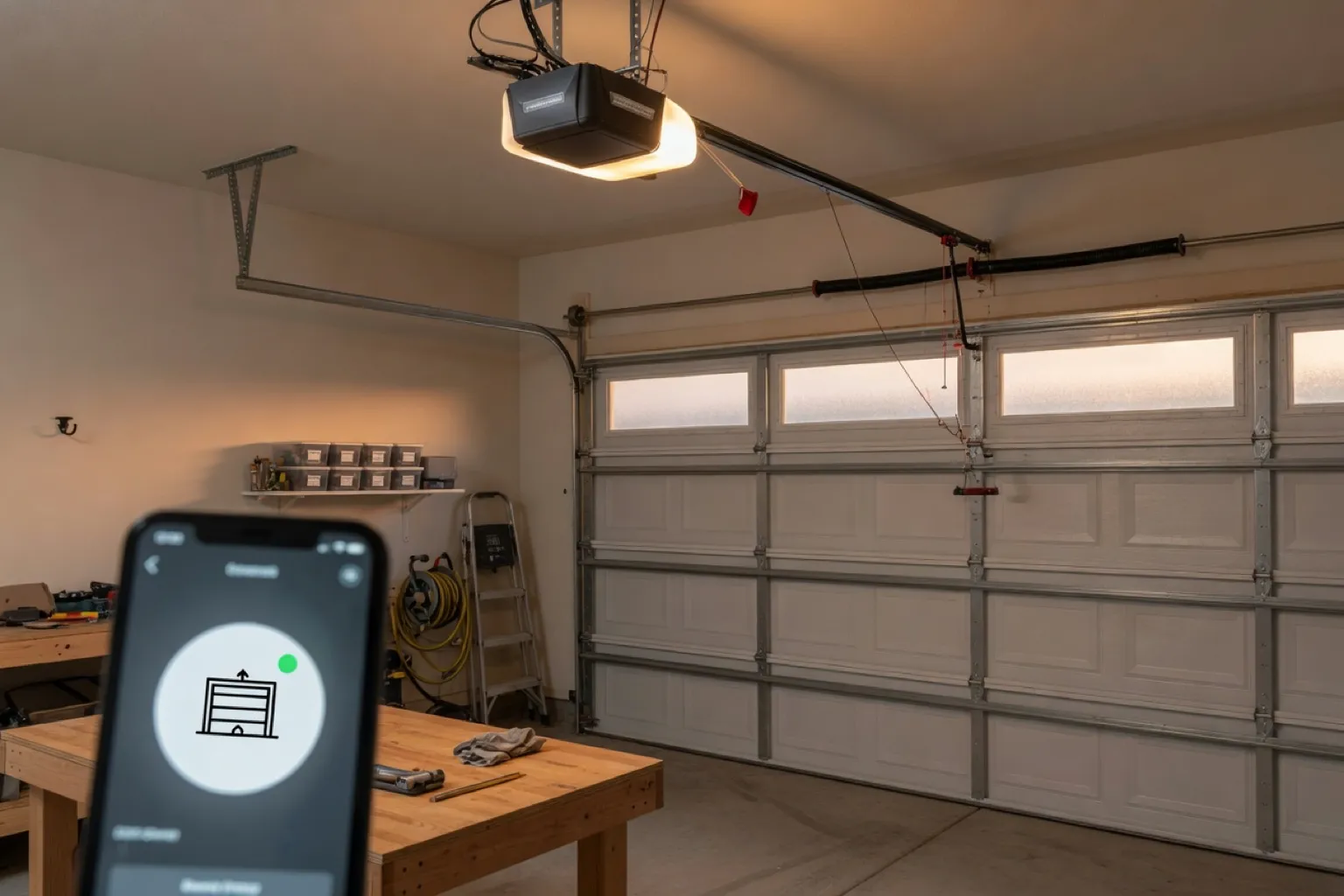
Smart garage door opener: add a hub or buy a new one?
Before you buy a smart hub, look at the learn button on your opener. Here is what works with what, and when a new smart opener is the better buy.
A stuck automatic gate usually has a plain cause: a dirty eye, a weak battery, a bound hinge. Here is what we check first and what is safe for you to try.
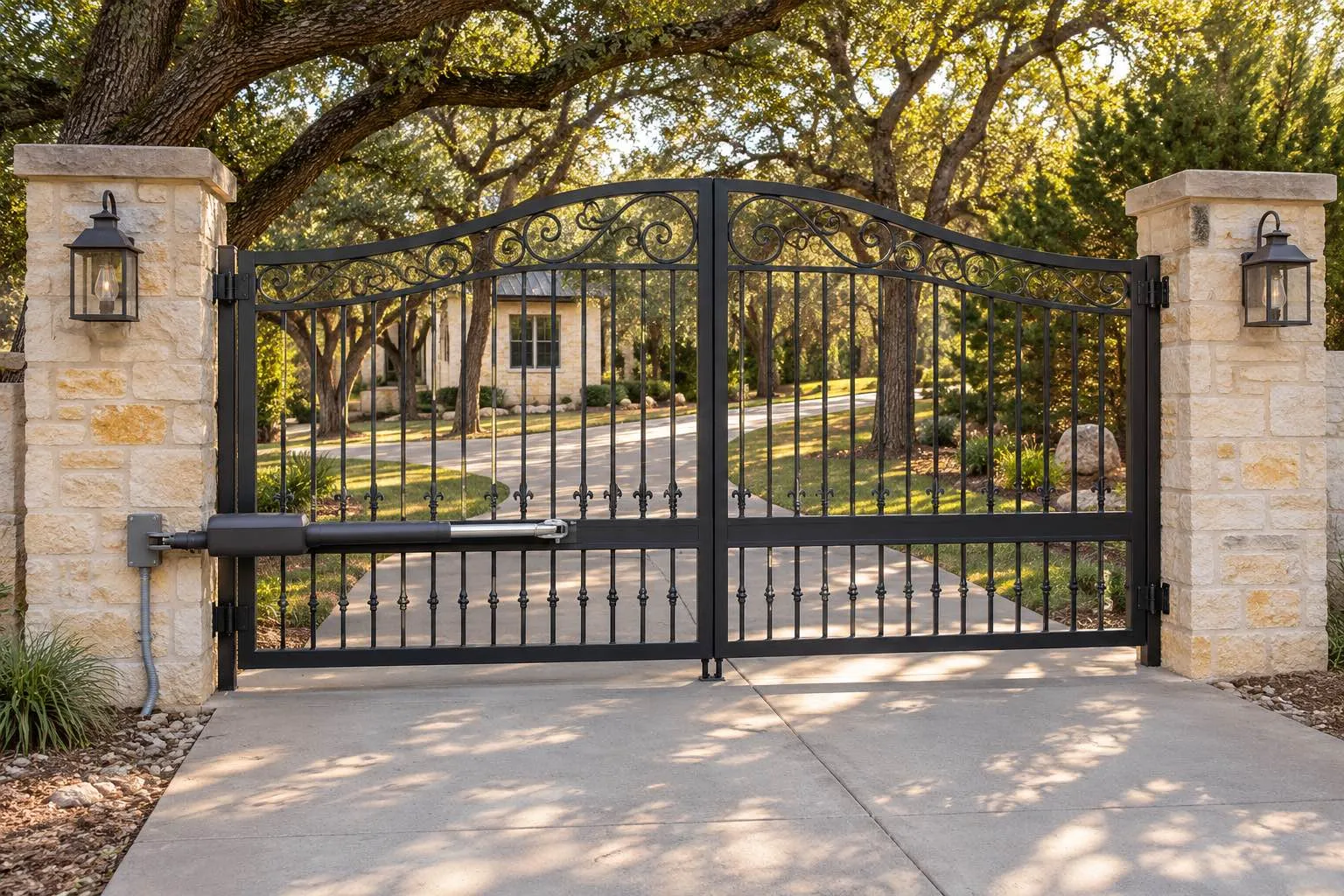
When someone calls us about a stuck gate, the first thing we ask is simple: what did the gate do right before it stopped? A gate that hums and does not move is a different problem from a gate that is silent, and a gate that closes and then bounces back is a third problem altogether.
This post walks through the order we check things, from the cheap and safe to the parts that need a technician. It covers swing and slide gates on a driveway. Start with safety, then work down the list.
An automatic gate is a heavy machine that can move without warning, so the first step is to keep people, kids, pets and cars out of its path. Do not reach through the bars, do not climb on it and do not ride it. A stuck gate can restart the moment a sensor clears or power returns.
Stay clear until it is dealt with. A moving gate can cause serious injury or death, according to DASMA, the door and access systems trade association. Keep kids and pets away from the whole path of travel, and never put a hand, arm or foot through a gate that has power.
Current UL 325, the safety standard for automatic gate operators, calls for at least two independent entrapment protection devices wherever someone could get caught. External devices such as photo eyes and sensing edges are monitored, which means the operator checks that each one is present and working. DASMA’s technical sheet on UL 325 explains the requirement in plain terms.
Why does that matter for troubleshooting? Because a gate that refuses to move is often doing exactly what it was built to do. If a safety device is missing, blocked or faulted, the operator can refuse to run, or run only while you hold the button down. Treat that as the gate telling you something, not a nuisance to defeat.
Start by listening and watching, because the sound and the motion narrow the cause fast. Does the operator hum, click, beep, stay silent or move and reverse? Each answer points to a different part, and some of them are safe for you to check while others are not.
The table below is how we sort it out on the phone before we ever arrive.
| What you see or hear | Likely cause | Safe to check yourself? |
|---|---|---|
| Gate opens, will not close | Dirty or misaligned photo eye, pressed safety edge | Yes, wipe the lens and look |
| Gate closes, then reverses | Safety device sees an obstruction, or limit setting has drifted | Look only, then call |
| Hum or click, no movement | Weak battery, drive jammed, gate binding | Look only, then call |
| Nothing at all, no lights | Power, tripped breaker, dead battery, blown fuse | Check the breaker and switch |
| Remote dead, keypad works | Remote battery or pairing | Yes, try a new battery |
| Keypad dead, remote works | Keypad power, wiring or water damage | Look only, then call |
| Gate drags or scrapes | Sagging leaf, bad hinge, shifted post | Look only, then call |
| Beeps or flashes an error | Control board or safety input fault | Note the pattern, then call |
Most of the “yes” rows cost nothing but a few minutes. For the rest, looking is fine and fixing is ours. Never open the operator box, and never reach into the drive while the gate has power.
This is a complaint we hear often, and the cause is usually the safety eyes. A gate that opens fine and will not close, or one that closes partway and bounces back, almost always thinks something is in its way. The first suspect is the photo eye pair at the gate opening.
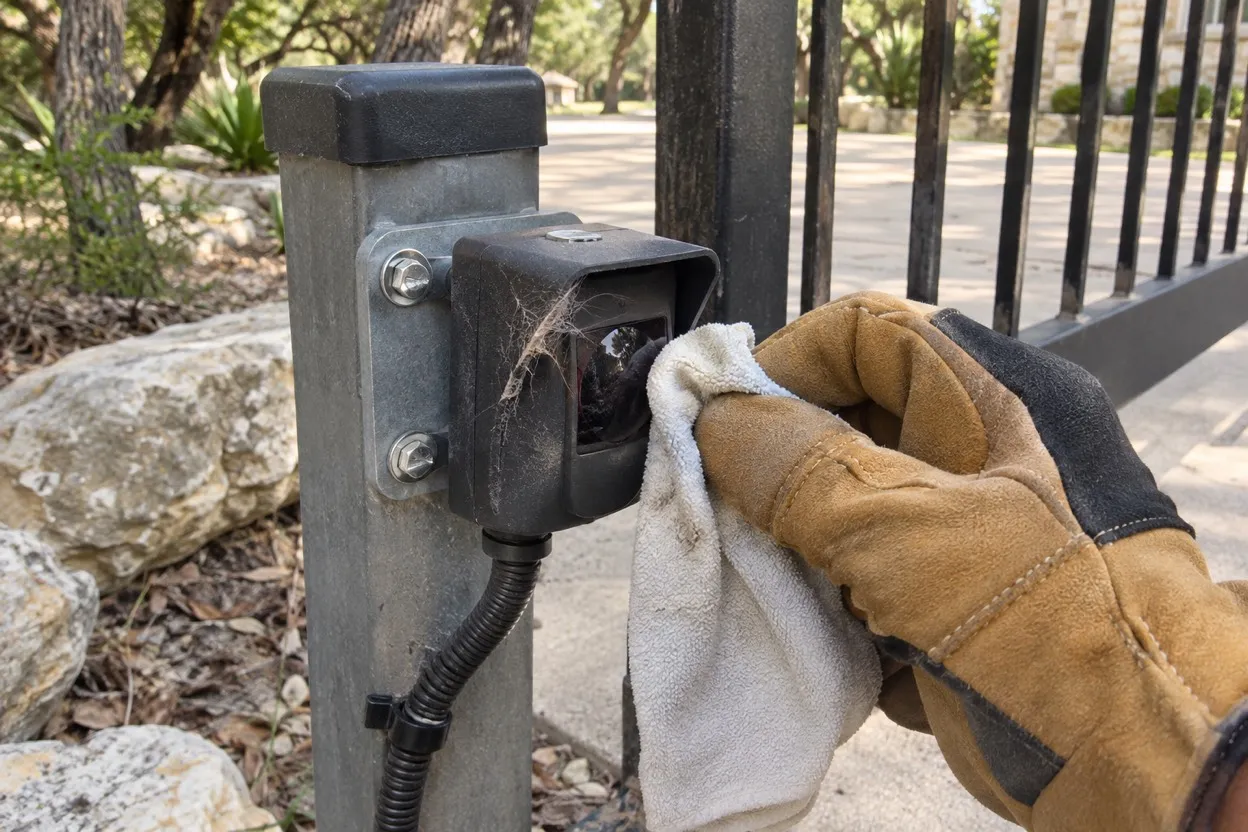
Photo eyes work as a pair. One side sends a beam, the other receives it, and if anything breaks the beam while the gate is closing, the operator stops or reverses. A film of dust, a cobweb, a wasp nest, a leaf stuck to a lens or a post knocked a few degrees out of line is enough to break that beam.
LiftMaster’s support pages say to inspect the photo eye for dust, debris, vehicles or people, and a gate that closes only while you hold the close button commonly points to a blocked or misaligned eye. Live oak leaves and pollen collect on lenses faster than most owners expect. Wipe both lenses with a soft dry cloth and look at whether the small indicator light on each eye is steady.
If the eyes are clean and lit and the gate still reverses, the next suspects are a sensing edge that is pressed or damaged, a limit setting that has drifted so the operator thinks the gate has hit something, or a loop detector in the pavement. Those need a technician with a meter. We test each safety input one at a time instead of bypassing any of them, because an automatic gate with no working safety devices is a safety problem.
When the gate is silent and the operator has no lights, work from the wall outward. Is the breaker on? Is the switch at the operator on? Is the solar panel clean, in the sun and connected? These are the same questions we start with, and sometimes the call ends right there.
If the power side checks out, the battery is next, and in Austin the battery is a very common culprit. Heat is hard on the sealed lead acid batteries that back up AC gate operators and run solar ones. Three sourced numbers show why.
The battery figures come from Battery University’s article on how heat and harsh loading reduce battery life, and the heat figure comes from the National Weather Service comparison of annual normals. Treat them as typical figures, not a promise about your battery. We cannot say how hot the inside of your operator box runs, so we do not guess.
What we can say is this: a battery that carried a gate through a long summer can fail on the first cold front, when the gate asks for more power to start moving. A battery that reads fine at rest can still collapse under load. That is why we test voltage while the gate is moving, not just with a meter on a sitting battery.
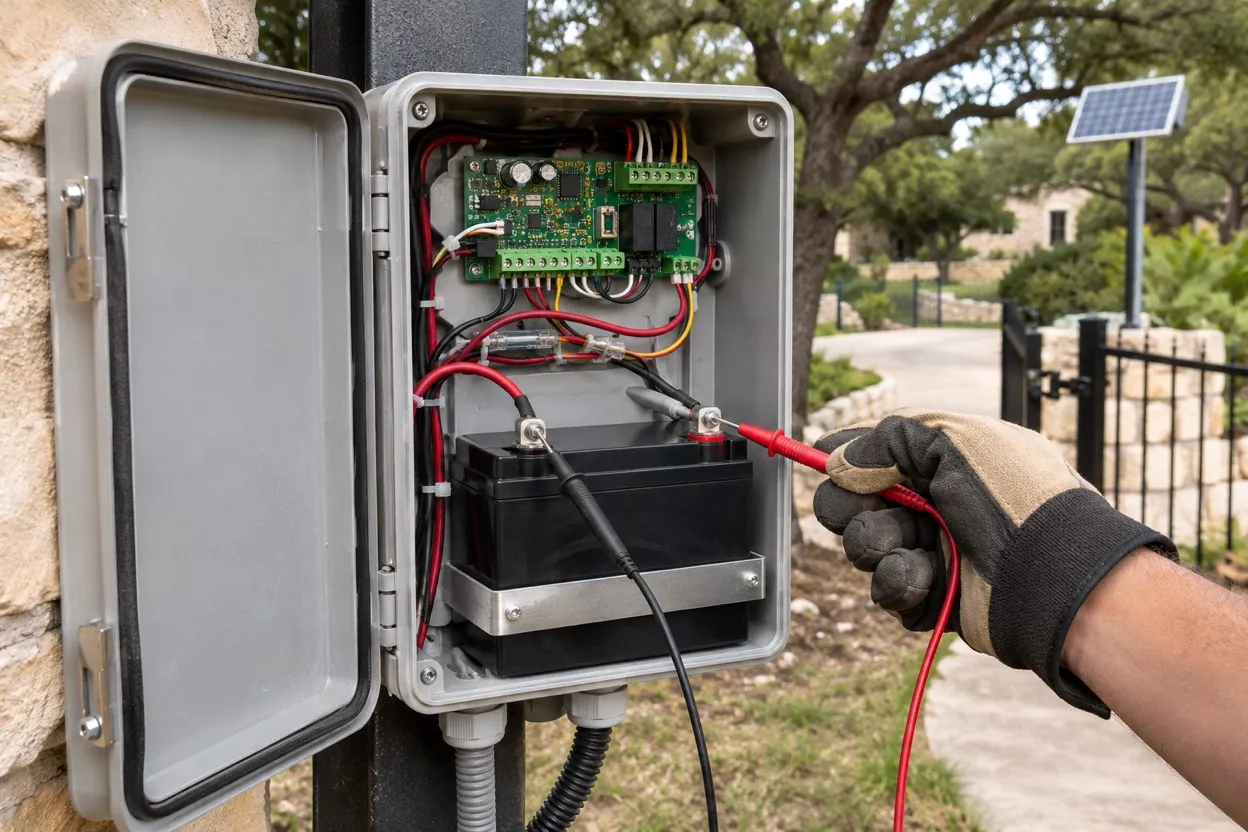
One manufacturer’s manuals list a charged battery at roughly 12.5 to 13.5 volts at rest, and note that a blown fuse or a dead cell can stop the operator. If your gate is solar, a dirty panel or a shaded one also starves the battery. Wipe the panel, trim anything shading it and let it charge a full sunny day before you decide it is dead.
If the operator moves when one control works but not another, the operator is fine and the problem is the device. Start with the plain things. Put a fresh battery in the remote, since a remote that has been in a car through a summer is often just tired. Try the keypad, then the remote, then the button at the operator.
If the keypad is the one that fails, look for water in the housing, a loose or corroded wire, or a worn keypad face. A keypad that works some days and not others often has moisture in it. On a gate with a call box or intercom, a dead unit can be a power problem, a wiring run damaged by a mower or a trencher, or a phone or cellular connection that dropped. Those are repairs for us, and our access control work covers keypads, remotes and call boxes. A keypad installed starts at $349.
DASMA’s gate owner safety guidance also says to mount controls at least 6 feet from moving parts, so nobody has to reach through or under a moving gate to use one. If yours is closer than that, mention it when we visit.
Many owners now want phone control too. If your operator accepts a Wi-Fi module, a gate app or module starts at $249 installed, and our smart gate access page covers what works with what. The module does not fix a bad battery or a dirty eye, so sort those out first. We cover the garage door side of this in our smart opener post.
Before you call anyone, there is a short sequence you can run in a couple of minutes without touching anything dangerous. Keep everyone clear while you do it, and stop the moment something looks wrong or a part moves unexpectedly.
If the gate still will not work after step 6, stop. Do not keep pressing the button or cycling the power, because repeated attempts can strain a drive that is already jammed.
Sometimes a car needs to get out while the operator is down, and the answer is the manual release. Every automatic operator has some way to disengage the drive so the gate moves freely. On many swing operators it is a key or lever on the arm, and on many slide operators it is a release on the drive. Where it is and how it works depends on the brand and model.
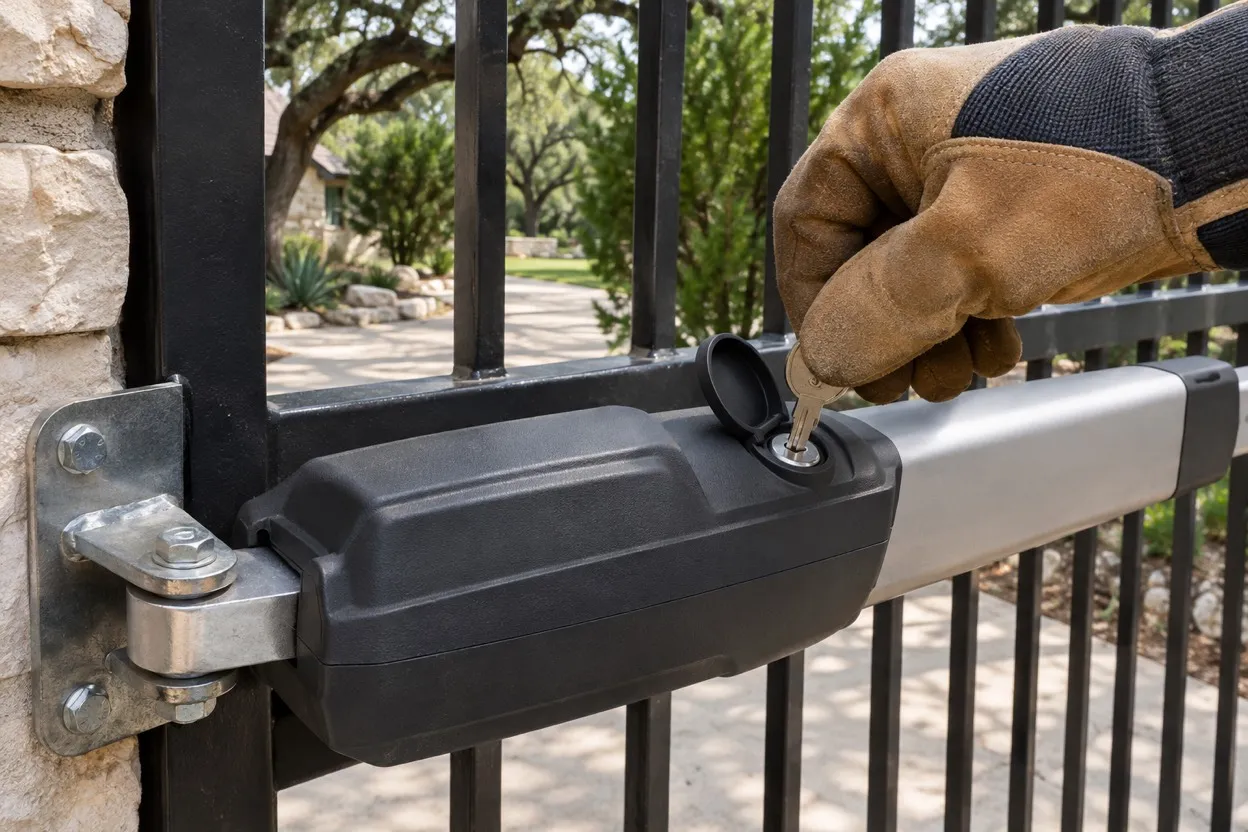
DASMA says an owner should know how to turn the power on and off and how to open and close the gate manually, but it does not give one procedure, because there is not one. So follow your operator’s manual, and if you do not have it, call us at (512) 777-0412 and we will walk you through the steps for your model.
Some safe habits apply to every gate. Turn the power off first, at the breaker if the operator’s switch is inside its box. Keep people and cars clear. Move the gate slowly and do not force a leaf that resists, because a gate that fights you is stuck on something, and forcing it can bend a hinge or hurt you. When the gate is in position, leave the operator released and call. Do not re-engage a drive you suspect is damaged.
An operator can only push what the gate lets it push. A gate that has sagged at the latch end, a hinge that has worn, or a post that has leaned will load the operator on every trip. The operator then draws more power, runs hot and eventually quits, and the operator gets blamed for a hardware problem.
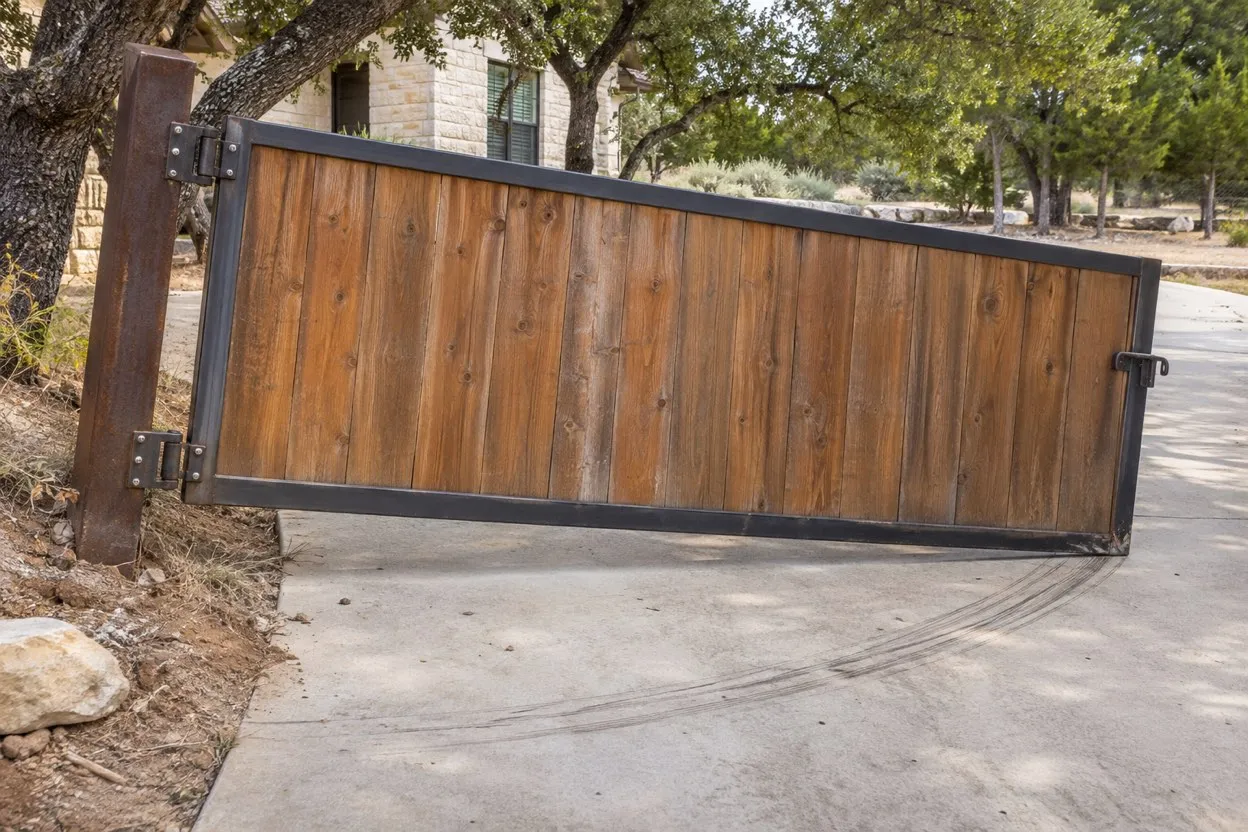
Look for arc-shaped scrape marks on the driveway, a gap that is wider at the top of the latch side than at the bottom, a gate that lifts or clunks as it swings, or a leaf that rubs the post. Those are signs the gate has dropped or a post has moved.
Texas A&M AgriLife Extension says Blackland clays in this area “tend to shrink and swell when exposed to moisture, forming wide cracks and heaving objects like fence posts and patios,” in its guide on Austin area soils. That is about fence posts, not gates. Our view, and it is only our inference, is that the same movement can shift a gate post or a hinge over a few wet and dry seasons, which is why we check posts, hinges and alignment on every gate visit around Round Rock and Georgetown.
A binding gate is a mechanical repair first. We straighten and re-hang the leaf or fix the post, then check the operator. Our page on driveway gates covers gate hardware, and if the gate or operator is past saving, operator installation covers the replacement. A single swing operator installed starts at $2,495, and a slide operator installed starts at $1,995.
The control board is the brain of the operator, and it does not like lightning, water or surges. If your gate went dead after a storm, or the operator shows no lights even though the breaker is on, a damaged board or a blown surge part is a real possibility.
Manufacturer documentation is cautious here. Chamberlain and LiftMaster say their surge module may not prevent damage in a direct strike, and some brands’ warranties exclude lightning and surge damage altogether. A proper ground matters too, because some instructions require the ground wire to go to an earth ground rod. We do not have a Central Texas figure for how often gates take lightning damage, so we do not quote one.
What can you do? Do not keep resetting a board that smells burned or shows no lights, and leave the box closed. Turn the power off and call. We inspect the board for burned parts and water damage, check the ground, and tell you whether a repair or a replacement board makes more sense before we start.
When we arrive at a stuck gate, we run a fixed order, because skipping steps is how a simple fix turns into a second visit. It mirrors the list on our gate opener repair page, and it is the same whether you are in Austin, Round Rock or anywhere else in our service area.
What we check on a gate service visit
The price rule is the same every time. A gate service call starts at $95, and opener repair starts at $149 plus parts. Gate prices are estimates until we see the gate, so after we find the cause you get the exact price in writing before any work begins. Parts carry the manufacturer warranty, and our labor carries a one year warranty.
If your gate is stuck right now, keep everyone clear, note what it did and call (512) 777-0412. We cover the Austin and Round Rock areas and the cities around them, open daily 7am to 8pm.
Keep people clear first. Then listen: a hum points to the battery or a jam, silence points to power, and a gate that opens but will not close points to the safety eyes. Wipe the lenses, check the breaker, try a fresh remote battery and look at the hinges and posts.
Use the manual release only after you read your manual, and stop forcing anything that resists. Anything with a board, a battery under load, a sensing edge or a loop detector is ours. Leave the gate where it is, keep kids and pets clear and call.
AK
Starting prices, installed. Your exact price is in writing before any work starts.
Most often the safety system thinks something is in the way. A dusty or misaligned photo eye, a pressed safety edge or a faulted sensor will make the operator refuse to close, or close and reverse. We clean and realign the eyes first, then test each safety device one at a time.
Only after the power is off and the operator is released with its manual release key or lever. Keep people, pets and cars clear, move the gate slowly and never force it. The release procedure differs by brand and model, so follow the operator manual, and call us if you are not sure.
Heat shortens the life of sealed lead acid batteries. Battery University says each 15 F rise in temperature cuts the life of a sealed lead acid battery in half. A battery that survived the summer can fail on the first cold morning, which is when many Austin owners notice.
A gate service call starts at $95 and opener repair starts at $149 plus parts. Gate prices are estimates until we see the gate. You get the exact price in writing before any work begins.
It usually points to the remote, not the operator. Try a fresh battery in the remote first. If a new battery does not help, the remote may need to be paired again, or the receiver may have a fault. We can check both.
Before you buy a smart hub, look at the learn button on your opener. Here is what works with what, and when a new smart opener is the better buy.
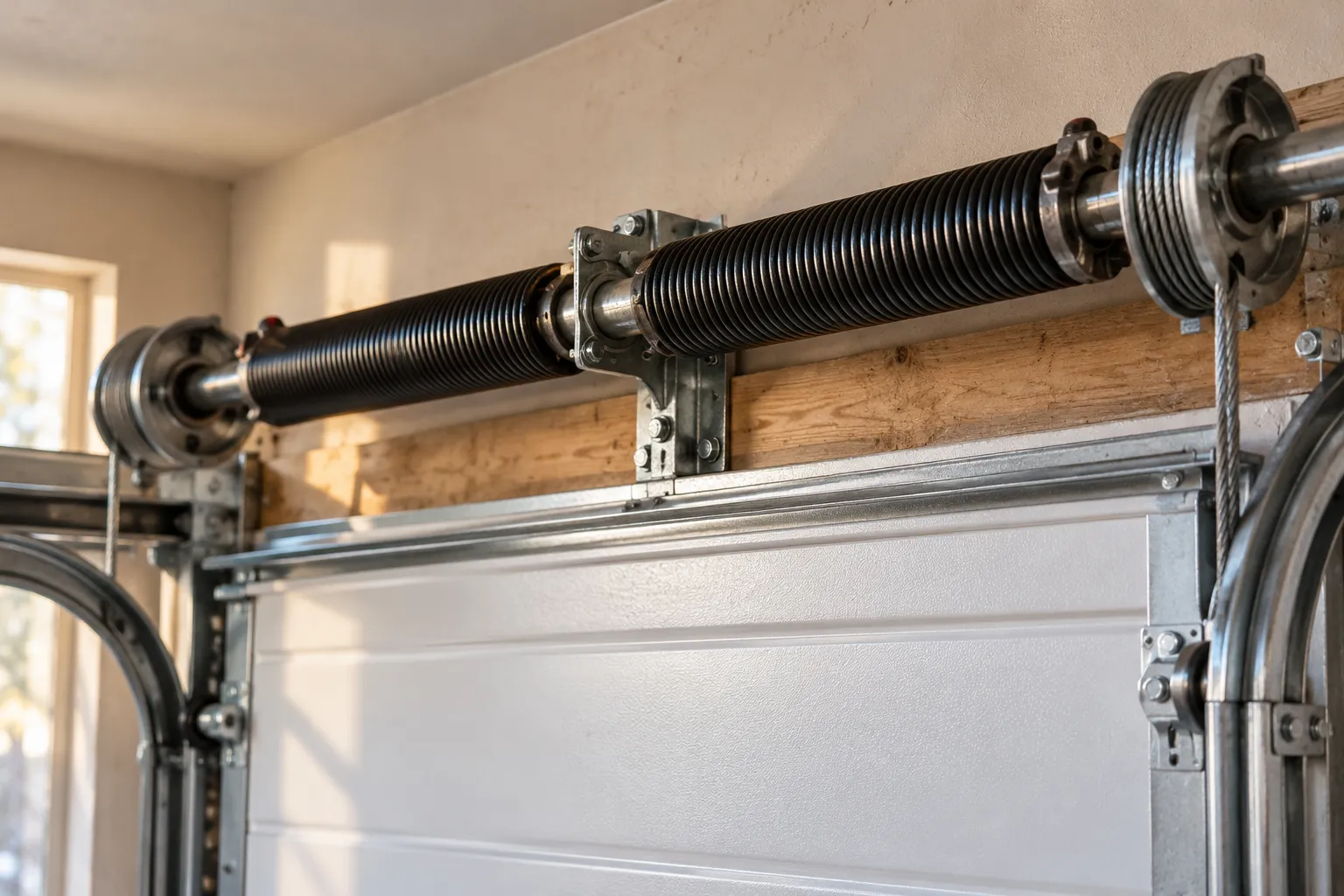
A standard torsion spring is commonly rated for around 10,000 cycles. Here is how to count your own trips, spot a failing spring, and know when to call.
Open daily 7am to 8pm. After-hours emergency line. 304 E Main St #204, Round Rock.